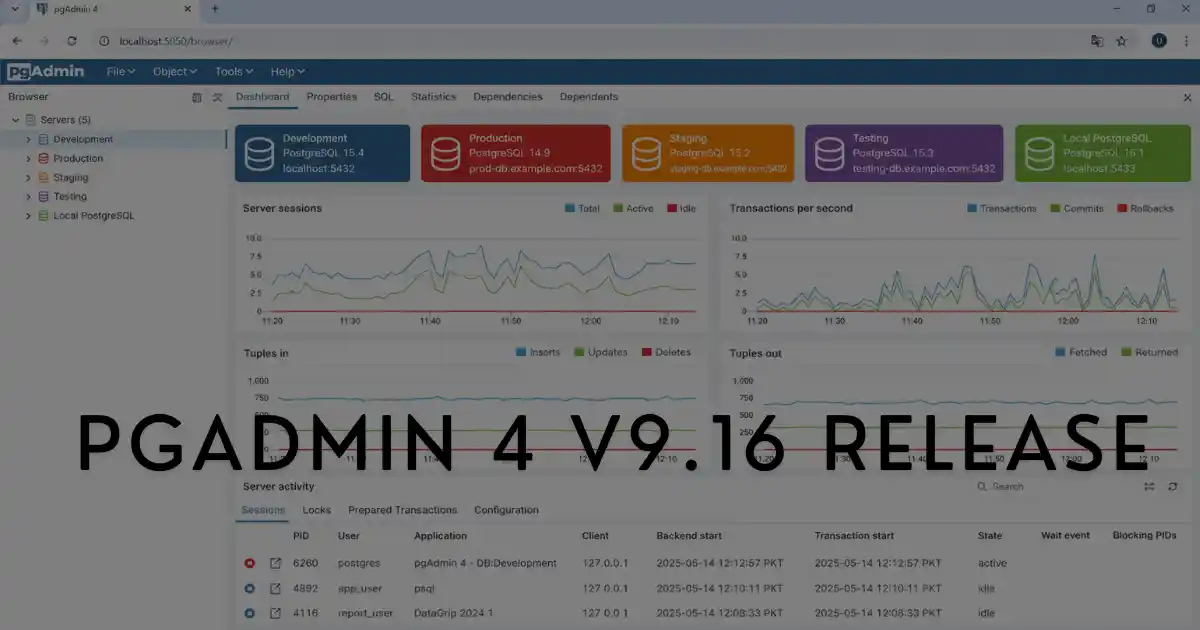
pgAdmin 4 version 9.16 brings essential security patches for seven vulnerabilities including SQL injection and stored XSS alongside new usability features. Database administrators must upgrade immediately to protect PostgreSQL environments from potential remote code execution and unauthorized access risks.
pgAdmin 4 v9.16 Matters for Every PostgreSQL User
PostgreSQL administrators worldwide rely heavily on pgAdmin as primary management interface. Recent pgAdmin 4 v9.16 release delivers major security improvements that every user needs right now. This update addresses seven critical vulnerabilities capable of enabling serious attacks. Database teams running older versions face real exposure risks today. Immediate upgrade becomes essential step for protecting production environments.
This June 2026 release combines sixty four bug fixes with fresh features while strengthening overall security posture. Security researchers identified multiple flaws ranging from SQL injection vectors to cross site scripting issues. Server mode deployments carry higher risk levels because pgAdmin runs as web service accessible over networks. Users managing multiple PostgreSQL instances benefit most from this timely patch.
Understanding Seven Critical Vulnerabilities Fixed in pgAdmin 4 v9.16
Core highlight of pgAdmin 4 v9.16 centers on resolution of seven tracked vulnerabilities labeled CVE-2026-12044 through CVE-2026-12050. Several flaws allowed authenticated attackers to achieve remote code execution under right conditions. Enterprise PostgreSQL setups require urgent attention here.
CVE-2026-12044 involved SQL injection present across sixteen dialog templates. User controlled input lacked proper sanitization allowing malicious query manipulation through COMMENT ON statements. Attackers could inject harmful descriptions to alter database structure or extract sensitive information. Developers implemented qtLiteral method along with OID casting to close this vector completely.
CVE-2026-12045 affected AI Assistant functionality. Read only transaction restrictions suffered bypass through prompt injection techniques. Malicious multi statement payloads executed successfully especially with superuser connections. COPY TO PROGRAM command opened pathway toward operating system level code execution. Updated transaction handling and stronger prompt sanitization eliminate this bypass.
CVE-2026-12046 exposed authentication weaknesses on two SQL Editor endpoints. Server mode installations permitted unauthorized access without proper login verification. Pickle deserialization risks compounded the problem. Implementation of @pga_login_required decorator across all sensitive endpoints resolves this exposure.
Additional issues included stored cross site scripting via CVE-2026-12048 where PostgreSQL error messages and query plans rendered malicious scripts. HTML injection through CVE-2026-12047 impacted cloud SDK error handling. Open redirect flaws in MFA flows and restore point SQL injection received fixes as well.
These vulnerabilities combined dangerous attack chains. Weak passwords or minor misconfigurations led to full environment compromise in past similar cases. Historical pgAdmin exploits involving regex bypass in dump restores and eval function abuse highlight ongoing need for vigilance.
Deep Dive How These Vulnerabilities Worked & Fixed
SQL injection mechanism relied on direct concatenation of user input into queries without parameterization. Special characters combined with crafted SQL snippets altered intended database operations. Secure coding practices now employ qtLiteral functions and explicit casting throughout dialog templates.
AI Assistant bypass demonstrated prompt injection power against read only wrappers. Superuser privileges amplified impact allowing operating system command execution via PostgreSQL COPY functionality. Team strengthened transaction boundaries and added robust input validation layers.
Stored XSS vectors stored payloads inside database object names or result cells. Interface rendering without escaping executed JavaScript in victim browsers. Modern sanitization pipelines prevent such content from reaching user sessions. Pickle deserialization risks stemmed from unsafe serialization formats controllable by attackers.
Dependency updates cover Electron runtime and cryptography libraries. These changes reduce supply chain attack surface while improving long term maintainability.
Methods to Check Your pgAdmin Instance is Vulnerable
Administrators verify current version through dashboard About section first. Versions below 9.16 remain exposed to known attack paths. Log analysis reveals unusual SQL activity or unexpected error patterns especially around AI Assistant usage.
Network monitoring tools capture unauthorized endpoint requests targeting SQL Editor functions. Web application firewalls configured with appropriate rules block suspicious patterns automatically. Docker and Kubernetes environments require careful review of running container versions and security contexts.
Regular vulnerability scans against pgAdmin installations provide early warning. Teams subscribe to official security mailing lists for future alerts.
Effective Mitigation Strategies
Upgrade process starts with downloading pgAdmin 4 v9.16 from official channels or pulling latest Docker image. Full testing in staging environments precedes production rollout. Strong multi factor authentication protects all server mode instances.
Least privilege principles limit administrative access strictly. Regular backup schedules combined with comprehensive monitoring detect anomalies quickly. Cloud deployments sanitize all SDK error outputs before display.
pgAdmin team deprecated pgAgent scheduling component encouraging modern alternatives. This reduces maintenance overhead significantly. Teams establish dependency update policies and conduct periodic security training sessions
Final Thoughts
pgAdmin 4 v9.16 release serves as important reminder about continuous maintenance needs for popular open source tools. Ignoring these vulnerabilities creates unnecessary data breach or system compromise possibilities.
Every PostgreSQL administrator benefits from prompt action here.Security represents ongoing journey requiring patched software alongside updated processes and team awareness. Strong PostgreSQL community continues delivering reliable management solutions through consistent improvements.
Protect infrastructure and data assets by adopting latest version today. This single update strengthens entire database management practice significantly.