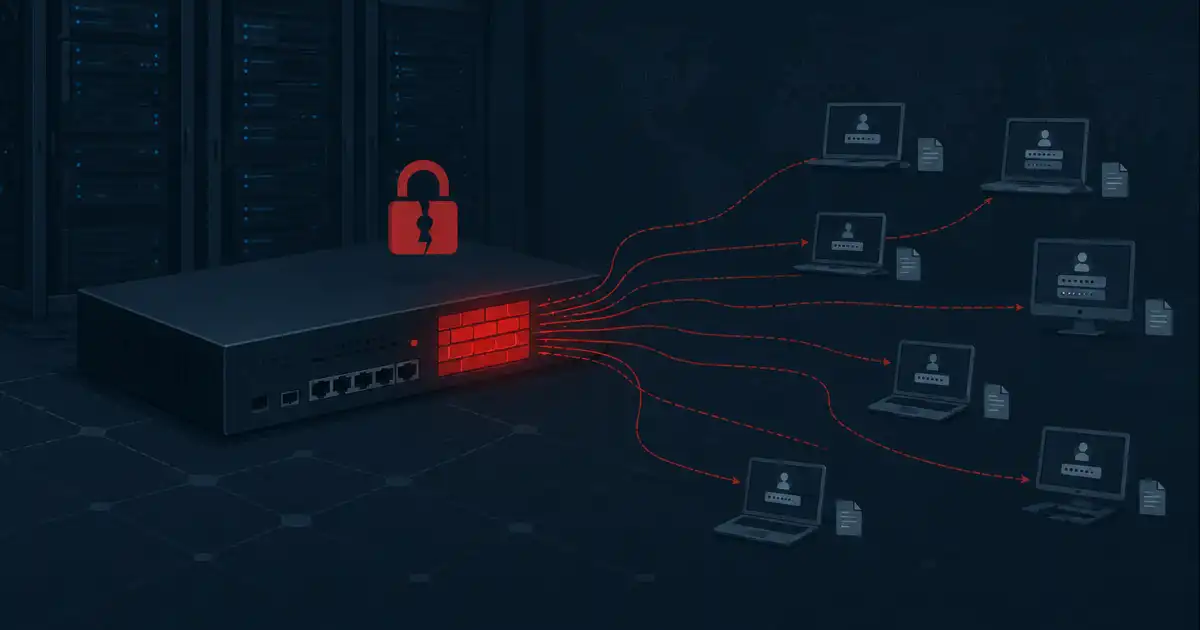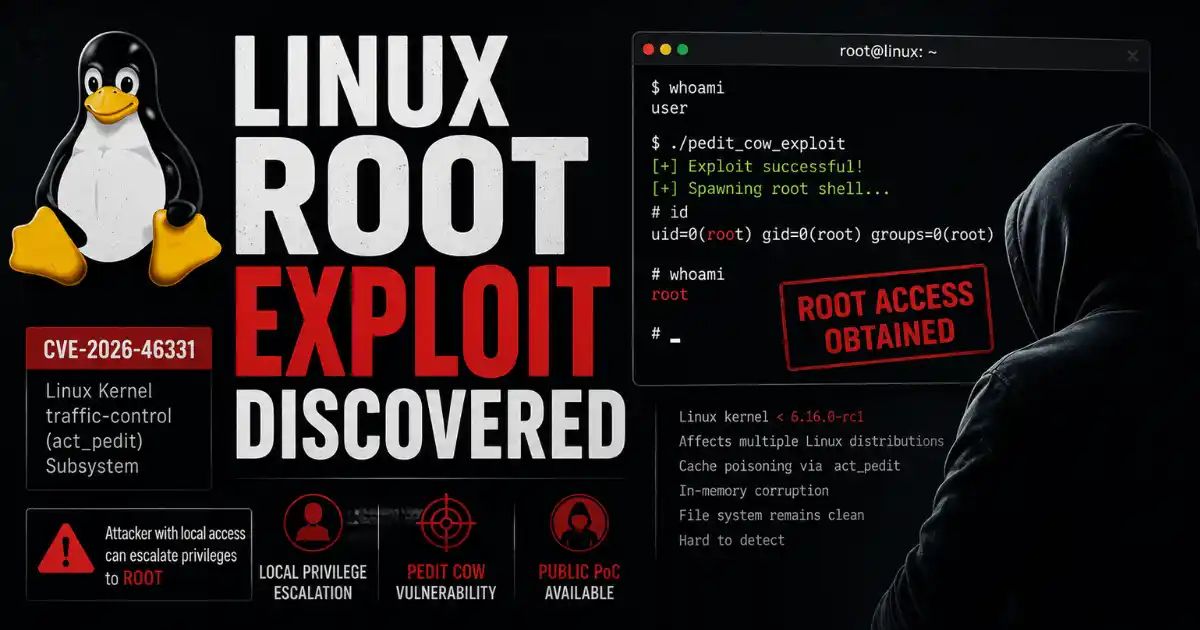
This guide explains how CVE-2026-46331 known as pedit COW lets local unprivileged users gain root access on Linux systems by corrupting shared page cache memory through the kernel act_pedit traffic control action.
Consider a normal low privilege user account on a shared Linux server silently escalating itself to root in seconds, leaving no trace on disc. File integrity tools report no problems. Audit logs are boring but a root shell is already open and waiting.
But thanks to a newly disclosed Linux kernel vulnerability that researchers have dubbed pedit COW this very situation has just become reality and deserves far more attention than a simple patch note buried deep in a changelog.
Pedit COW Kernel Vulnerability Technical Explanation Details
Security researchers tracked this flaw as CVE-2026-46331 and tied it to the Linux kernel traffic control subsystem. The bug lives inside a packet editing action called act_pedit which network administrators normally use to rewrite packet headers on the fly. Red Hat rated this flaw as important and a working public exploit landed on GitHub within a single day after the CVE got assigned on June 16. That speed alone tells defenders everything about how fast this particular weakness moved from quiet disclosure into a real weapon.
What makes me really creepy about this exploit is how it’s done. The attack never touches any file on the disc. Instead it poisons the cached copy of a setuid root binary in memory such as the common su program. It injects a small malicious payload directly into that cached image and the corrupted version runs as root as soon as anyone runs it. Disc based integrity checks see anything wrong since the actual file on disc hasn’t changed. Meanwhile, on the compromised machine afully functional root shell is already open.
Two specific conditions need to line up for this exploit to fire. First the act_pedit kernel module needs to remain loadable on the target system. Second unprivileged user namespaces need to stay open which hands a regular local account a namespace scoped version of CAP_NET_ADMIN capability. That single capability becomes the key that unlocks the entire attack chain. Researchers confirmed both conditions sat present by default on tested RHEL and Debian systems which explains why this flaw spread concern so quickly across enterprise environments.
Understanding why this bug exists requires a quick look at how the Linux tc tool handles packet rewriting. The kernel function responsible for this work called tcf_pedit_act normally follows a copy on write pattern meaning it should create a private copy of packet data before making any edits. The problem traces back to timing. This function checks the writable memory range only once and it does this check before the final write offsets actually get resolved.
Some pedit edit keys only calculate their real offset later during runtime execution. When that calculation happens after the initial check the resulting write lands outside the privately copied region entirely and ends up corrupting a shared page cache page instead. If that particular page happens to belong to a cached file the in memory image of that file gets silently altered.
This shape of bug feels familiar to anyone who tracked recent Linux kernel security research. Dirty Pipe Copy Fail DirtyClone and Dirty Frag all shared a nearly identical root cause pattern where a fast kernel code path writes into memory it does not exclusively own and the shared page cache absorbs the damage. What sets pedit COW apart comes down to the entry point itself.
Earlier bugs in this family often needed more obscure access paths while this one opens through something far more common. Any unprivileged user able to configure tc actions from inside a standard user namespace automatically receives the exact capability needed to trigger the underlying flaw.
Linux Privilege Escalation Detection And Exploit Indicators
Detecting this style of attack proves genuinely difficult precisely because the overwrite targets cached memory rather than anything stored permanently on disk. Standard file integrity monitoring tools that hash files and compare checksums against known good values will report everything looking perfectly normal even while an attacker already holds a root shell. This blind the spot makes behavioral monitoring far more valuable than static file checks for catching this specific exploit class.
Security teams running multi tenant infrastructure should watch closely for unusual tc command execution coming from accounts that normally never touch network configuration tools. Any unprivileged process loading the act_pedit module or constructing pedit rules outside of expected network administration workflows deserves immediate investigation. Kernel logs and audit trails capturing user namespace creation events paired with subsequent privileged operations also offer a useful detection signal since the exploit fundamentally depends on combining those two elements together.
Organizations running shared infrastructure such as CI and CD build runners Kubernetes worker nodes containerized build environments and shared research lab machines face the highest exposure since these environments routinely grant local accounts to many different users or automated processes who genuinely should never need root access. Any sudden unexplained privilege escalation event traced back to a low privilege build job or container runtime process running on one of these systems warrants treating that host as potentially compromised until proven otherwise.
The affected system list spans a wide range of popular distributions. RHEL 10 and Debian 13 known as trixie shipped with unprivileged user namespaces open by default which made successful exploitation straightforward on those targets. Ubuntu 24.04 only became exploitable when execution routed through AppArmor profiles that still permitted user namespace usage.
Ubuntu 26.04 blocks this particular attack path by default since its AppArmor profiles restrict unprivileged user namespaces outright even though the underlying kernel code itself remains vulnerable. Patch status also varies sharply by vendor. Debian already fixed trixie through its standard security channel while Debian 11 and 12 still sit listed as vulnerable.
Ubuntu currently lists every supported release stretching from 18.04 through 26.04 as vulnerable as of June 25. Red Hat lists RHEL 8 9 and 10 as affected while RHEL 7 does not appear in their bulletin at all.
Patch Update And Mitigation Strategy For Pedit COW
The single most effective fix remains straightforward. Install the patched kernel build from your distribution vendor and reboot the affected system promptly. Priority should go first toward any environment where local user access does not automatically mean trusted user access including multi tenant hosting platforms CI and CD runners Kubernetes nodes shared build workers and research or lab machines used by multiple people.
Organizations unable to patch immediately still have two practical mitigation paths available. Systems that genuinely never need tc pedit rules can check whether the module sits currently loaded and then block it from loading again through a simple modprobe configuration entry. This single step effectively removes the vulnerable code path from ever executing on that machine.
The second mitigation involves disabling unprivileged user namespaces entirely at the kernel parameter level. This removes the namespace local capability the exploit depends on completely but it comes with real tradeoffs since many rootless container setups certain CI sandboxes and sandboxed browser processes also rely on unprivileged user namespaces to function correctly. Testing this change carefully in a staging environment before rolling it out broadly remains essential.
For any system suspected of already facing exploitation the situation grows more serious. Dropping the page cache through a simple proc filesystem command clears out the poisoned in memory copy of whatever binary got targeted. However that single action does absolutely nothing to close a root shell an attacker already opened before that cache got cleared. Any system showing signs of this exploit having already run should get treated as fully compromised rather than simply cleaned and trusted again.
Time management, not technical complexity, is probably the most striking detail in this whole affair. The actual fix for this bug landed quietly on the kernel networking mailing list back in late May as nothing more than a routine data corruption fix. No CVE existed yet.
No security warning accompanied it. The genuinely exploitable detail sat openly visible on a public mailing list for weeks before anyone formally flagged it as a security issue. Only once the fix got merged on June 16 did the CVE finally get assigned and a fully weaponized proof of concept followed within a single additional day. For kernel bugs involving page cache corruption like this one waiting around for an automated scanner rule to catch up proves far too slow a strategy to rely on.
This entire episode delivers one clear lesson every infrastructure team should internalize going forward. A patch commit message calling something routine never guarantees the underlying issue stays harmless and any environment treating local user access as inherently low risk needs to rethink that assumption immediately given how quickly a quiet kernel fix can turn into a fully working root exploit.