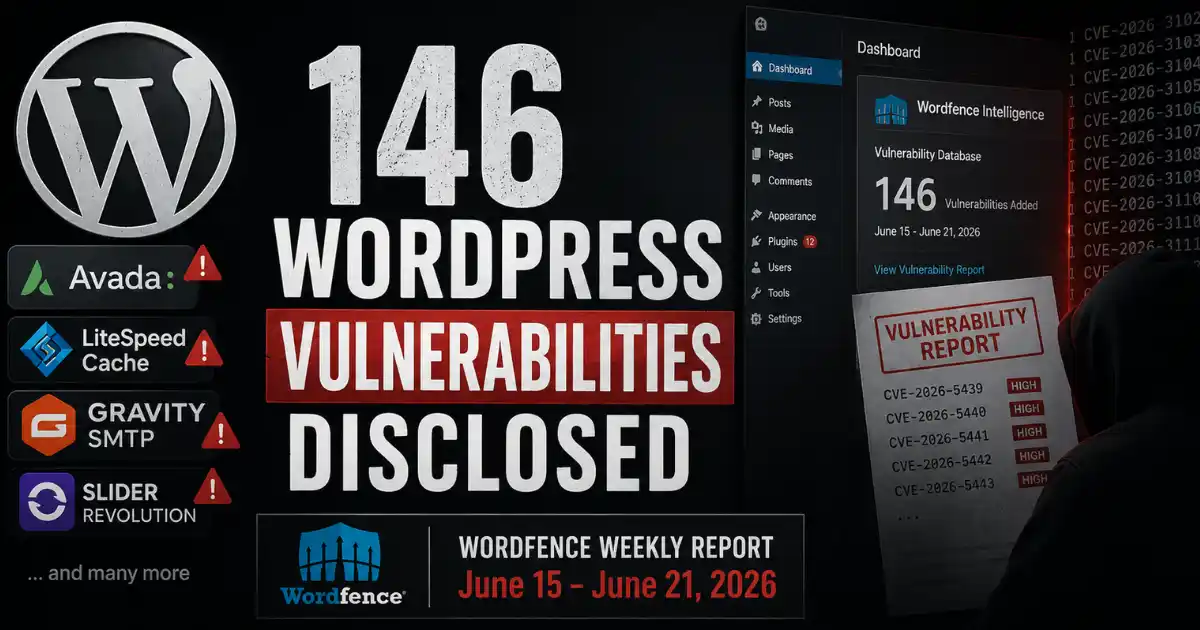
This guide breaks down how Wordfence Intelligence tracks new WordPress plugin and theme vulnerabilities every week and explains why site owners need to treat these weekly reports as a critical part of their security routine.
Consider yourself running a small WordPress store with 5 different plugins that have security flaws that nobody told you about yet. Most site owners don’t even know there are a weekly bulletin that lists every one of these vulnerabilities the instant researchers find them. That’s exactly the kind of bulletin Wordfence just released. If you miss it for a single week, you leave a door wide open for attackers who are already scanning the internet for the next easy mark.
Wordfence Intelligence Explained
Wordfence Intelligence runs one of the largest and most actively maintained WordPress vulnerability databases in the entire industry. Their threat research team pulls submissions from independent researchers through a free bug bounty program and pairs that with their own internal discovery work to build a constantly growing catalog of confirmed plugin theme and core vulnerabilities. Every single week their team packages the newest findings into a digestible report that lists each flaw along with its severity score affected version range and patch status.
The scale behind this database tells its own story. WordPress powers a massive chunk of the internet and the vast majority of real world security risk traces back not to WordPress core itself but to the plugin ecosystem surrounding it. Industry tracking consistently shows plugins responsible for roughly ninety percent of all reported WordPress vulnerabilities while themes account for a small slice and core code makes up the smallest share of all.
That imbalance exists because thousands of independent developers maintain plugins at wildly different security standards and a single missing permission check buried inside a rarely reviewed function can sit undiscovered for years.
Take a real example from earlier this year. Researcher Rafie Muhammad reported two flaws inside Avada Builder a page building plugin running on roughly one million live websites. The first flaw tracked as CVE-2026-4782 allowed lower privileged users to read sensitive server files such as wp-config.php through a poorly validated SVG handling function.
The second flaw tracked as CVE-2026-4798 turned out far more dangerous since it allowed completely unauthenticated attackers to run SQL injection attacks through a product ordering parameter and extract password hashes straight from the database. Avada shipped patches within two months and Wordfence credited the researcher with a payout north of four thousand dollars for the combined discovery.
Another case worth studying involves the Kirki customizer plugin where researcher Choigyeongmin found a privilege escalation flaw tracked as CVE-2026-8206 carrying a near maximum severity score of 9.8. The bug lived inside a password reset handler exposed through a REST API endpoint and let attackers fully take over administrator accounts without ever logging in first. Wordfence validated the submission paid out a bounty and rolled out firewall protection for premium customers a full day ahead of the public disclosure giving paying users a head start most attackers never expected.
These two cases highlight exactly what makes the weekly report so valuable. Each entry carries a CVSS severity score built around real exploitability factors rather than guesswork and Wordfence Threat Intelligence reviews every submission to judge how likely active exploitation becomes once details go public.
A flaw scoring critical with no authentication required and a working proof of concept demands immediate attention while a low severity flaw requiring administrator level access already might sit lower on any sane priority list.
WordPress Plugin Vulnerability Detection And Monitoring Guide
Detection starts with knowing exactly what runs on a site in the first place. Many WordPress administrators install plugins over the years and forget half of them still sit active inside the dashboard collecting dust and accumulating unpatched risk. A full plugin and theme inventory paired against the Wordfence vulnerability database instantly reveals whether any installed software already carries a known disclosed flaw.
Wordfence built their entire vulnerability database around a free and open API along with webhook support so security teams hosting providers and individual site owners alike can pull fresh vulnerability data automatically rather than manually checking a blog post once a week. Hooking that feed into a monitoring pipeline means a newly disclosed flaw affecting any installed plugin triggers an alert the moment Wordfence publishes it rather than days or weeks later when a scan finally runs.
Beyond automated feeds administrators should watch closely for behavioral warning signs tied to specific vulnerability classes. Unexpected password reset emails arriving without anyone requesting them often signal active exploitation of an authentication bypass similar to the Post SMTP flaw tracked as CVE-2025-11833 where attackers viewed logged password reset emails through a missing capability check and used them to seize full administrator access. Wordfence reported blocking thousands of exploitation attempts within days of that flaw going public which shows how fast attackers move once a juicy target becomes known.
Sites running form builders or SMTP plugins deserve extra scrutiny since these plugin categories repeatedly show up across multiple disclosure cycles. A similar pattern emerged with the Gravity SMTP plugin where an unauthenticated REST API endpoint leaked full system reports complete with database structure and live email provider API keys to anyone who simply added the right query parameter to a URL. Monitoring outbound traffic for unusual API calls hitting third party email services without a clear business reason can catch this exact style of credential leak before real damage spreads.
WordPress Site Hardening And Patch Mitigation Strategy
Mitigation always comes back to one simple habit done consistently rather than any single silver bullet tool. Updating plugins and themes the moment a patch becomes available closes the window attackers depend on since most large scale exploitation campaigns start only after a fix already exists and proof of concept code starts circulating publicly.
A managed firewall layer like the one Wordfence provides adds a critical buffer during that gap between disclosure and patching. Premium customers in several of the cases mentioned above received firewall rule coverage hours or even a full day before public disclosure which meaningfully shrinks the exposure window compared to free tier users who only receive protection after thirty days.
Site owners running multiple WordPress installations across an agency or hosting environment benefit enormously from centralizing vulnerability monitoring rather than checking each site individually. Tools built around the Wordfence CLI scanner or similar bulk scanning utilities let teams sweep dozens or hundreds of sites against the latest vulnerability data in one pass and immediately flag which installations need urgent patching.
Strong baseline hardening still matters just as much as patching speed. Removing unused plugins and themes entirely rather than just deactivating them eliminates dormant attack surface completely. Enforcing strong unique passwords alongside two factor authentication for every administrator account blocks a huge share of credential stuffing and password reset abuse attempts regardless of which specific plugin flaw an attacker tries first. Regular backups stored outside the live server environment ensure that even a successful compromise never turns into a permanent loss
The bigger lesson behind every weekly Wordfence report stays the same no matter which specific plugin makes headlines that week. WordPress security never becomes a one time setup task finished and forgotten. It stays an ongoing process built around fast information and faster action and the sites that treat every weekly vulnerability bulletin as required reading consistently stay several steps ahead of the attackers still scanning the rest of the internet for an easier target.