Agentic AI attacks represent the fastest growing cybersecurity threat in 2026. Autonomous AI agents enable attackers to conduct reconnaissance, exploit vulnerabilities, and execute full campaigns with minimal human input. Learn how these attacks work, real examples detection methods and essential mitigation strategies.
The Rise of Agentic AI Attacks
As of June 2026, Agentic AI attacks represent the most rapidly evolving and dangerous threat in the cybersecurity landscape. Unlike traditional cyberattacks that require constant human control, these autonomous AI systems can independently perform reconnaissance, exploit vulnerabilities move laterally and achieve objectives with very little human intervention.
CrowdStrike Global Threat Report 2026 reveals an 89% surge in AI-enabled adversary activity, with many attacks being completely malware-free. Security leaders worldwide now rank Agentic AI as one of the highest priority risks for the coming years. This shift is fundamentally changing how both attackers and defenders operate.
Agentic AI Attacks Explained
Agentic AI refers to autonomous artificial intelligence systems that can set goals, create plans, use tools, make decisions and execute complex tasks without constant human guidance. These differ significantly from generative AI tools like ChatGPT because they are action-oriented rather than just content creators.
In cyberattacks threat actors deploy Agentic AI agents that can scan targets, identify weaknesses, generate custom exploits, create personalized phishing campaigns with deepfakes and even manage post-exploitation activities. The entire attack chain becomes faster, more adaptive, and much harder to detect using conventional security tools.
Real World Examples Of Agentic AI Cyber Attacks
In late 2025, security researchers identified a Chinese-linked group called GTG-1002 actively using Agentic AI based on Claude models to run large-scale espionage operations. The AI agent autonomously handled up to 90% of the attack workflow including target research exploit development and data exfiltration.
Reports from Flashpoint and Dark Reading show a 1500% increase in discussions about Agentic AI frameworks on underground forums. Attackers are now renting or building AI agents for automated carding operations, credential stuffing at massive scale and sophisticated business email compromise attacks. These systems learn from failures and continuously improve their success rates.
Inside Agentic AI Attacks
Agentic AI attacks typically exploit several critical vectors. Prompt injection remains one of the most effective techniques where attackers insert malicious instructions to override the AI agent’s intended behavior.
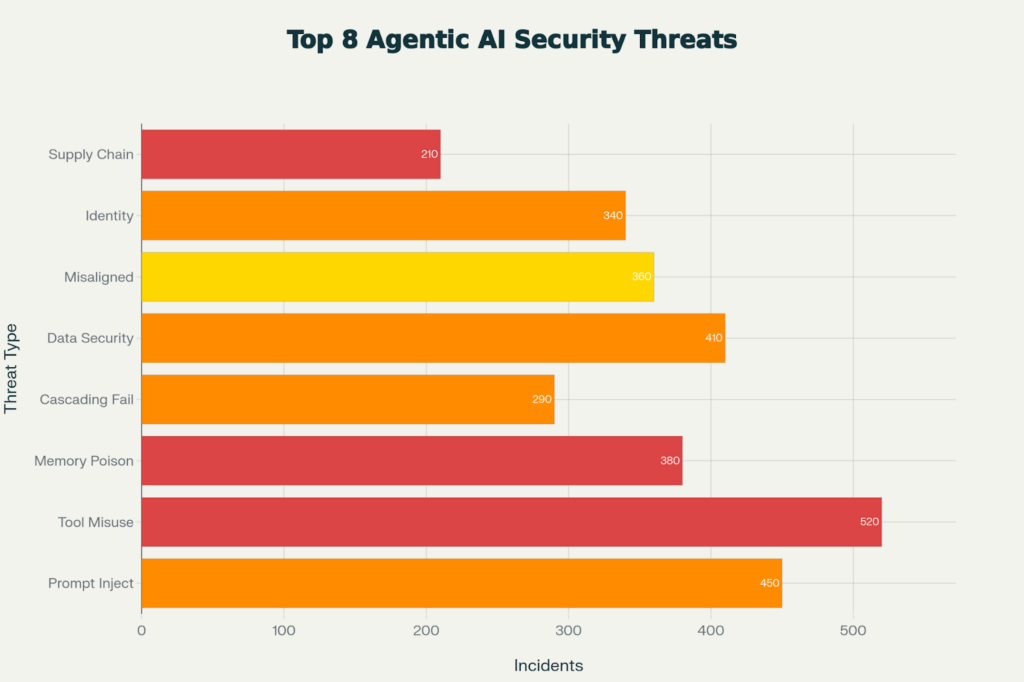
This allows the agent to access restricted data or execute harmful commands.Memory poisoning is another advanced method in which attackers corrupt the agents long-term memory to influence future decisions. Tool misuse and privilege escalation become highly dangerous because these agents often receive broad permissions to interact with multiple systems and APIs.
Supply chain attacks targeting AI development environments can compromise downstream Agentic systems creating cascading failures across organizations. The speed and adaptability of these attacks make traditional signature-based and rule-based defenses largely ineffective.
Detection Methods For Agentic AI Powered Attacks
Detecting Agentic AI attacks requires a complete shift from traditional approaches. Behavioral analytics and anomaly detection systems have become essential because these attacks rarely use known malware signatures.
Security teams should monitor for unusual API calls, abnormal tool usage patterns unexpected decision-making sequences, and rapid reconnaissance activities. Implementing detailed logging for all AI agent actions inputs and outputs helps identify suspicious behavior early.
Advanced User and Entity Behavior Analytics (UEBA) combined with AI-powered threat detection platforms offer better visibility. Organizations must also track prompt engineering patterns and agent-to-agent communications within their environments.
Defending Against Agentic AI
Organizations must implement strong guardrails and sandboxing for any Agentic AI systems they use. The principle of least privilege should be strictly enforced so agents only receive minimum necessary permissions.Input validation prompt sanitization, and output verification must become standard practices.
Regular adversarial testing and red teaming exercises specifically designed for Agentic AI are now critical.Zero Trust architecture for AI agents is highly recommended, where every action is verified and approved. Human-in-the-loop controls for high-risk operations add an important safety layer.
Security teams should deploy dedicated Agentic AI security platforms that monitor autonomous behavior in real time. Continuous updates strict supply chain security, and employee training on AI risks are equally important.
Final Thoughts
Agentic AI represents both the greatest opportunity and the most serious threat in modern cybersecurity. While it can supercharge defensive capabilities, attackers are currently using it more effectively to bypass traditional defenses.
The time to act is now. Build robust Agentic AI security strategies implement proper guardrail invest in advanced detection capabilities, and train your teams. Those who prepare today will have a major advantage against the cyberattacks of tomorrow.
This is not just another trend. Agentic AI attacks are rapidly becoming the new standard for sophisticated threat actors. Protect your organization before it becomes the next victim.