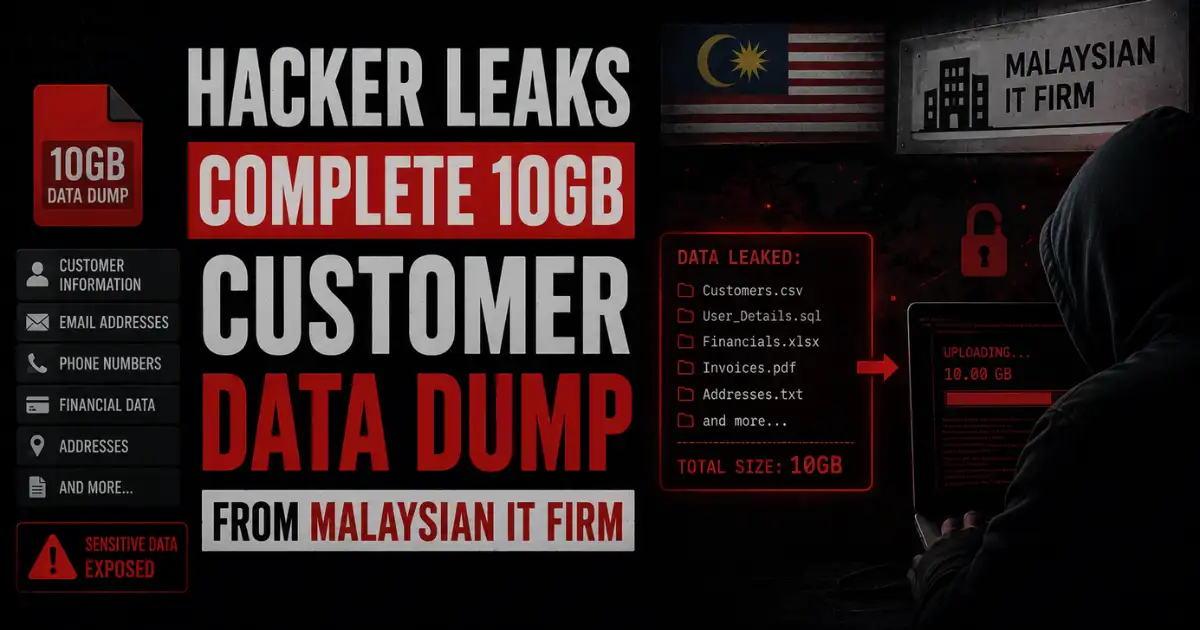
The DarkFourms report covers the ML IT Partners data breach where a threat actor calling itself 820X leaked a complete 10 gigabyte data dump containing customer records financial documents and internal files after the Malaysian company denied the incident.
Imagine a small, trusted Microsoft Dynamics partner, depended on by companies across the entire country to run their accounting, payroll and customer management systems. Now imagine that same partner publicly denying any breach while a hacker silently uploaded 10 full gigabytes of its internal data to a free file sharing service out of sheer frustration. That exact scenario just played out against ML IT Partners Sdn Bhd a Malaysian software company and it offers a textbook lesson in what happens when denial replaces disclosure in a ransomware negotiation.
ML IT Partners Data Breach Incident Overview Details
ML IT Partners has operated in Malaysia for more than two decades and built a solid reputation as a Microsoft Dynamics certified partner offering enterprise resource planning and customer relationship management solutions.
The company runs as a fully locally owned software house headquartered in Sri Petaling Kuala Lumpur and stays small by design with somewhere between eleven and fifty employees serving clients spread across agriculture finance healthcare and retail sectors. That client diversity matters enormously here because any breach hitting an ERP and CRM provider rarely stays contained to just one victim.
A threat actor going by the handle 820X published a forum post titled ML IT complete data dump describing it as roughly ten gigabytes in size. The post opened with a direct line aimed straight at the company stating that the release happened only after ML IT failed to reach a resolution and publicly denied the breach ever occurred.
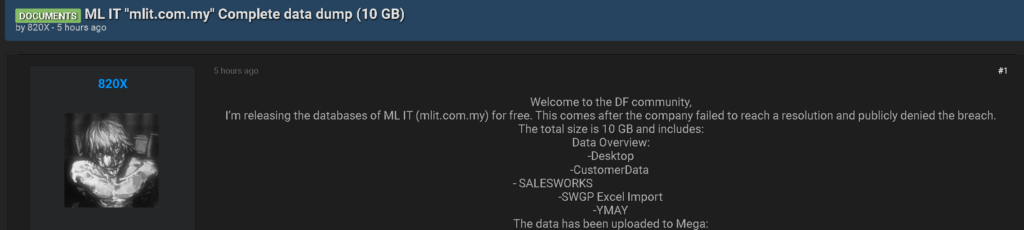
This detail carries real weight inside the ransomware ecosystem since public denial almost always escalates a quiet extortion attempt into a loud public leak. Attackers running these campaigns typically use the threat of exposure as leverage during private negotiation and once a victim denies the incident outright that leverage often gets cashed in through a full public release instead.
The leaked folder structure named inside the post included categories labeled Desktop CustomerData SALESWORKS SWGP Excel Import and YMAY. These names point toward internal project directories and what appear to be client specific ERP modules or workflow systems tied to ML IT’s Dynamics consulting work rather than generic personal files.
The attacker stated the complete dataset got uploaded to Mega a popular cloud storage service frequently abused by leak actors because of its large free storage tier and resistance to quick takedown requests.
Separate threat intelligence tracking around the same window identified the ransomware group Stormous independently claiming responsibility for a near identical breach against the exact same domain. That parallel claim described the stolen material in far more financial detail including complete campaign profit and loss statements detailed revenue sheets clawback records and general ledger accounts spanning multiple linked business entities.
The same report mentioned complete internal directory trees and file structures pulled directly from internal network shares alongside material captured from remote desktop sessions. Whether these represent two separate intrusions or one shared dataset redistributed across multiple leak communities remains unclear but either explanation points toward the same underlying conclusion. ML IT suffered a deep and thorough compromise rather than a shallow surface level data grab.
820X Leak Technical Explanation And Stolen Data Scope
Understanding why an ERP and CRM consulting firm becomes such an attractive target requires looking past the company size and toward what that company actually holds. A Microsoft Dynamics partner routinely maintains elevated administrative access into numerous client environments simultaneously since their entire business model depends on configuring and maintaining those systems remotely.
A single compromised account inside a partner like ML IT can theoretically become a pivot point reaching into dozens of downstream client networks rather than just the partner’s own internal infrastructure.
The mention of remote desktop session data inside the Stormous claim strongly suggests the initial access vector involved either brute forced or stolen RDP credentials a pattern seen repeatedly across small and mid sized business compromises throughout the region.
Attackers scanning the internet for exposed RDP ports remain one of the single most common entry points into smaller IT service providers precisely because these organizations often lack the dedicated security staff that larger enterprises maintain.
Once inside the network the presence of complete internal directory trees taken from network shares points toward extensive lateral movement rather than a quick smash and grab operation. Attackers typically spend real time mapping out file servers identifying high value financial folders and methodically copying entire directory structures before triggering encryption or extortion demands.
The fact that full accounting backend material such as profit and loss statements and general ledger accounts ended up in the stolen dataset confirms the intrusion reached deep into core business systems rather than stopping at a single isolated workstation or shared drive.
The CustomerData folder named specifically inside the 820X leak post deserves particular attention since this category likely contains personal and business information belonging to ML IT’s actual clients rather than just internal company records.
Any organization that engaged ML IT for Dynamics implementation work over the years should treat this leak as a potential indirect exposure event even if their own systems never experienced direct compromise. Supply chain breaches like this one frequently expose downstream client data precisely because service providers retain historical project files customer contact details and sometimes even client system credentials long after a project wraps up.
Data Breach Mitigation And Incident Response Guide
Organizations that worked with ML IT Partners on any Dynamics or ERP engagement should treat this incident as an active risk requiring immediate review rather than something to monitor passively from a distance. The first practical step involves rotating any credentials shared with ML IT during past or current engagements including service accounts VPN access and any remote support tools that granted the partner direct access into internal systems.
Credentials reused across multiple platforms become especially dangerous once a vendor breach occurs since attackers routinely test stolen username and password combinations against banking portals email accounts and other business critical platforms.
Businesses should also audit exactly what remote access channels they previously granted to ML IT and confirm those channels stay closed unless actively needed for legitimate ongoing work. Leaving a vendor remote access tool permanently enabled long after a project finishes creates exactly the kind of standing access path attackers love to discover and abuse.
Enforcing multi factor authentication on every remote access point combined with strict network segmentation between vendor access zones and core financial systems significantly reduces how far a single compromised credential can travel.
For ML IT itself and any similarly sized IT consulting firm watching this incident unfold the broader lesson centers on incident response transparency rather than denial. Security researchers and threat intelligence trackers consistently observe that public denial following a credible leak claim almost always backfires by provoking a full data release that otherwise might have stayed contained to a smaller private negotiation.
A documented incident response plan built around early acknowledgment legal consultation and proactive client notification tends to produce far better long term outcomes than silence followed by a public denial that later gets disproven.
Smaller technology consulting firms across Southeast Asia and beyond should treat this breach as a wake up call regardless of whether their own name appears anywhere inside the leaked archive. Disabling direct internet exposed RDP access enforcing least privilege on every service account and conducting regular third party security audits represent baseline defensive steps that would have meaningfully raised the cost of this exact intrusion path.
Monitoring dark web forums and leak marketplaces for early mentions of an organization’s name also provides a crucial early warning system since these posts frequently surface hours or days before mainstream security outlets pick up the story.
This entire episode reinforces a pattern that keeps repeating across the global ransomware landscape. Small trusted service providers sitting quietly in the middle of larger business ecosystems often carry far more risk than their size suggests and the moment that risk gets exploited the damage rarely stays confined to just one company walls.