The Interlock ransomware exploits the critical Cisco FMC zero-day CVE-2026-20131, which allows for unauthenticated RCE and root access. Discover the impact, flow, and mitigation of attacks.
Introduction: A Critical Cisco FMC Zero-Day Active Exploitation
The Interlock ransomware group is actively exploiting a critical zero day vulnerability known as CVE-2026-20131 which has rocked the cybersecurity landscape.This vulnerability affects Cisco Secure Firewall Management Center (FMC) a key enterprise security tool for large scale firewall policy management and network security.
This vulnerability classification as an unauthenticated remote code execution (RCE) which enables attackers to compromise systems without requiring login credentials and makes it especially dangerous with a maximum CVSS score of 10.0, This exploit falls into one of the most serious categories of cybersecurity threats, putting businesses at immediate risk of ransomware deployment, data exfiltration and complete network compromise.
Technical Breakdown of CVE-2026-20131 Vulnerability
An insecure debugging vulnerability in Cisco FMC’s Java-based components is the source of CVE-2026-20131 which allows attackers to send specially constructed payloads that run arbitrary code on the target system. Because it completely circumvents authentication procedures and allows attackers to function with root-level privileges this kind of vulnerability is especially dangerous.
Threat actors can take complete control of the firewall management system once they have been exploited and converting a defensive security layer into an attack vector.Because FMC centrally controls firewall rules, policies and visibility throughout enterprise networks, adversaries can manipulate traffic flows, turn off security and establish persistent backdoors without being discovered right away by taking advantage of this vulnerability.
Attack Chain and Exploitation Strategy of Interlock Ransomware
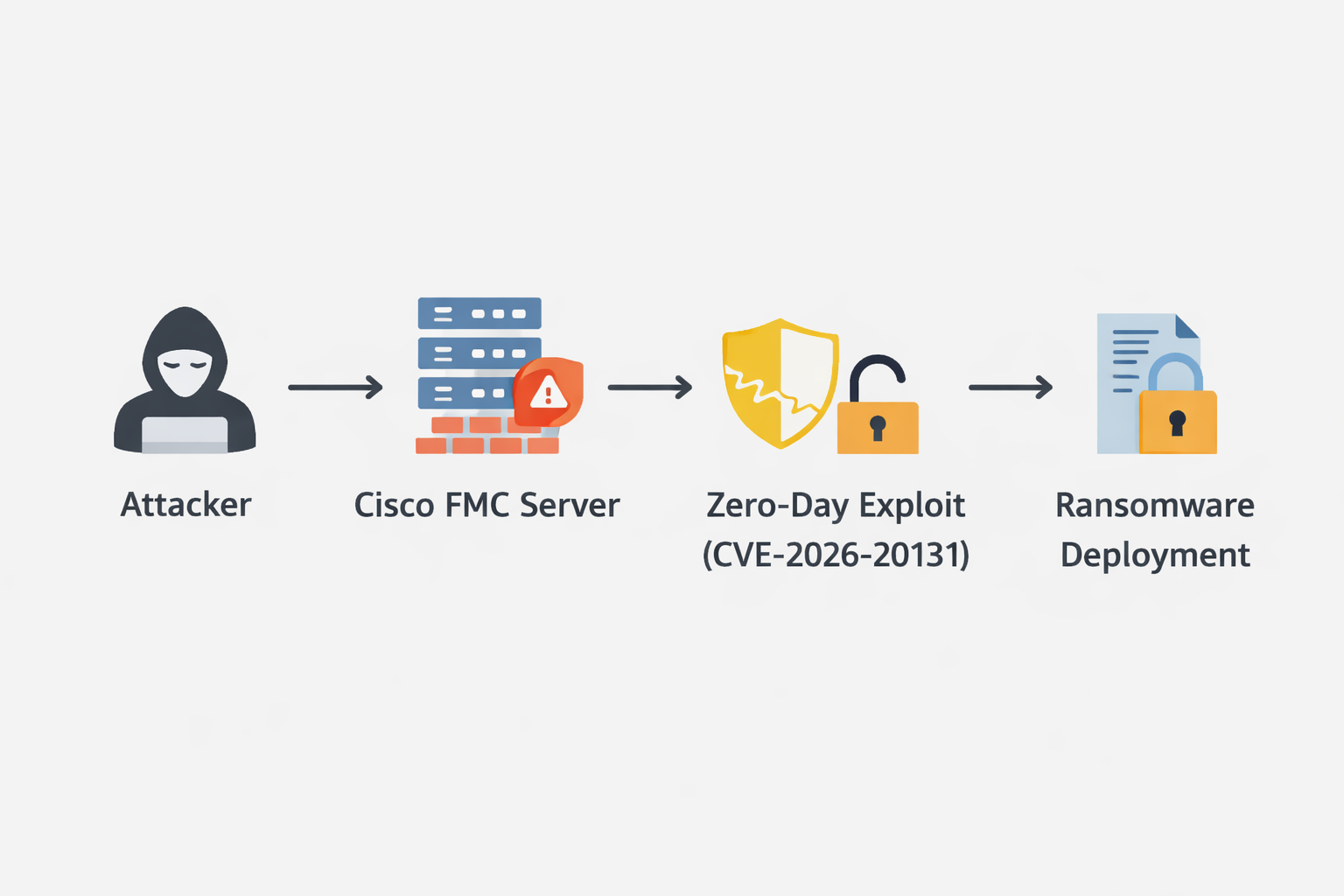
This zero-day vulnerability has been executed by the Interlock ransomware group into a structured attack chain aimed to have the greatest possible impact. Direct exploitation of exposed FMC instances is used to obtain initial access, which is then escalated to the root level.
Once inside attackers map the network environment, locate sensitive data repositories and identify critical assets through internal reconnaissance.After that the attack moves to payload deployment which involves the execution of ransomware binaries and remote access trojans (RATs).
In line with contemporary double-extortion strategies, this permits both system encryption and data exfiltration. Controlling firewall configurations improves the attack even more by enabling malicious traffic to evade detection systems and blend in with normal network activity.
Effects on Businesses and Network Security in the Real World
For organisations especially those with management interfaces exposed to the internet and the exploitation of Cisco FMC presents a high impact risk scenario.Because FMC serves as a centralised control point and enterprises entire security architecture is effectively undermined by compromise.
Firewall rules can be altert by attackers to permit unauthorised access, turn off logging and preserve network persistence. Widespread repercussions result from this such as operational disruption, monetary losses from ransomware demands and possible legal repercussions for data breaches.
Threat actors have a big advantage in targeting unpatched systems because this vulnerability was exploited as a zero day for weeks before to public disclosure which makes the situation even worse.
Guidelines for Security and Prevention Techniques
Organisations need to take an immediate and active security safety precaution in order to defend against CVE-2026-20131.The most important step in reducing this vulnerability is applying vendor patches that Cisco has released.The attack surface is also greatly decreased by limiting access to FMC interfaces through network segmentation and the removal of public exposure.
To find indications of compromise, especially unusual administrative actions or unauthorised configuration changes, threat hunting, anomaly detection and ongoing system log monitoring are crucial.Defences against ransomware campaigns can be further strengthened by implementing a zero trust architecture in conjunction with endpoint protection and intrusion detection systems.
Rapid response and layered security controls continue to be the best methods for averting significant cyber incidents in the constantly changing threat landscape.