A large database allegedly containing personal data of more than 8.3 million Israeli citizens was leaked by the self-described hacker collective INDOHAXSEC with 2GB of data spread across 1,600 files and the breach which is purportedly the result of the General Election results raises grave concerns about identity theft and the growing role of hacktivism in international geopolitical conflicts.
The Nature of the Breach: INDOHAXSEC Claims
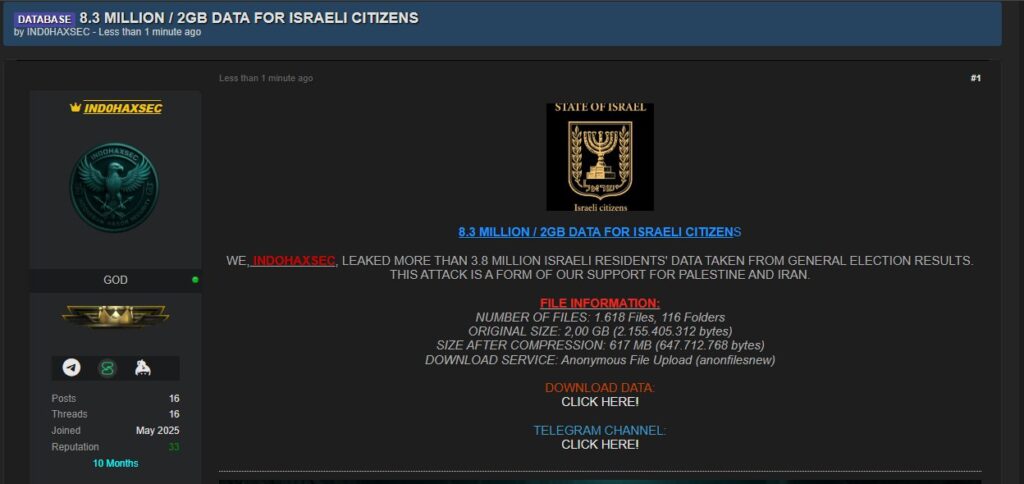
The findings that are of a major data breach that targets Israeli citizens are circulating in cybersecurity circles. On a dark web forum, a group going by the name INDOHAXSEC recently claimed to have leaked a database with data on about 8.3 million people.The attackers claim that the information was stolen from General Election Results and comprised more than 1,618 files arranged into 116 folders.
Although the group has made the 2GB dataset accessible for download through anonymous hosting services, independent security researchers are still questioning the data’s precise age and authenticity.
Exposed Data: What Information Has Been Leaked?
The hacker group’s post claims that the leaked dataset is large and purports to include private information about a sizable segment of the Israeli populace. The following are the breach’s precise technical details:
- Total Records: 8.3 million entries, which may represent the great majority of people living in the nation.
- Data Source: Voter registration databases and general election results are allegedly the sources of the files.
- File Composition: There are 1,618 separate files in the leaked package, arranged into 116 folders.
- Data Size: To make distribution easier, the database’s initial uncompressed size of 2.00 GB has been reduced to 617 MB.
- Potential Risk: Election leaks usually include Full Names, National ID numbers, home addresses and polling station assignments and all of which are goldmines for identity theft and social engineering, even though the precise fields aren’t fully verified.
Geopolitical Motivations and the Risks of Hacktivism
This incident is being classified as Hacktivism since the group made it clear that the attack was done to support Iran and Palestine. Frequently the goal of such breaches is not only financial gain but also public alarm.There is a significant risk of identity theft, targeted phishing campaigns, and social engineering attacks for the citizens affected by the election-related data leak. From the standpoint of international security, this incident emphasises the growing trend of digital warfare, in which private civilian databases are used as collateral in geopolitical conflicts.