In one of the most significant nation-state cyber espionage disclosures of 2026.Bitdefender threat research team has unmasked a sweeping campaign by APT36 (Transparent Tribe) a Pakistan-aligned advanced persistent threat (APT) group that has fundamentally pivote its malware development model.By harness AI large language models (LLMs) to mass-produce disposable and polyglot malware implants dubbed vibeware.APT36 is flooding Indian government and diplomatic networks with a relentless.AI-assisted wave of cyber intrusion tools trading sophistication for sheer, overwhelming volume.
Inshort the Pakistan linked hacker’s group APT36 is now utilized Artificial Intelligence (AI) to developthe new types of malware that can be modified rapidly and produced in massive quantities. The group is currently launching an overwhelming number of attacks on Indian government computer systems, making them increasingly difficult to intercept.
1. What Is Vibeware and Why Is It So Dangerous?
The term vibeware coined by Bitdefender researchers describe the AI-generated malware is produced rapidly using LLM code assistants and often without deep experties in the language or security logic being employed.The name derives from vibe coding, a development philosophy where a programmer prompts an AI tool to generate working code on demand and iterating quickly rather than engineering carefully. In the context of nation-state cyber operations this model has profound consequences.
APT36 now operates a malware-a-day production cadence generating a new type of unique binary variants every 24 hours.The evidence of AI involvement is conclusive by Bitdefender researchers found metadata within the group project files pointing directly to the AI-integrated code editors and the binaries themselves frequently contain Unicode emojis embedded in code strings.A telltale signature of LLM generated content that no human developer would manually insert.
Further degrade detection rates.APT36 deliberately uses niche programming languages including Nim, Zig, and Crystal.Most commercial endpoint detection engines have been trained on behavioral patterns from the common languages like C++ and C#.When malware is written in a language the engine rarely encounters its heuristics detection capabilities are significantly degraded even if the underlying malicious logic is identical to well known attack patterns. LLMs make this language switching trivial where a human developer would need months to learn Zig an AI assistant can port malicious logic into it in minutes.
2. The Full Attack Chain: How Indian Government Networks Are Compromised
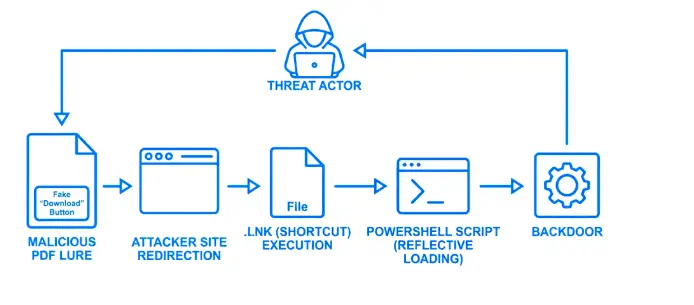
APT36 infection campaigns begin with highly targeted spear phishing emails delivering malicious Windows shortcut files LNKs bundled inside ZIP archives or ISO disk images.A second delivery vector are uses PDF lures featuring prominent Download Document buttons that redirect victims to attacker controlled infrastructure. Once a government official opens the malicious LNK file it silently executes PowerShell scripts directly in memory and bypassing filesystem based antivirus tools that monitor for suspicious file writes and downloads the primary backdoor alongside that known adversary simulation frameworks including Cobalt Strike and Havoc and creating multiple redundant access pathways.
APT36 keeps a foothold by tweaking the Windows shortcuts for Chrome and Edge.Whenever an official clicks the browser icon a hidden spying process slips in behind the legitimate app.Since the browser is opened dozens of times a day the malware remains in plain sight avoiding any suspicion.The trick is simple yet modify the shortcut.So that a stealth process launches in tandem with the normal program giving the attackers lasting access without alerting anyone.
BackupSpy is a custom harvesting tool that acts like a digital dragnet.It scans every connected drive and USB device automatically looking for 16 high‑value file types.Those include Microsoft Office documents (.docx, .xlsx, .pptx), PDFs, images (.png, .jpg) and web files (.html) Once the scan finishes, it quietly stages the files for exfiltration. The tool prioritizes documents that are most likely to contain military personnels records, diplomatic cables, defense procurement data or strategic policy briefings exactly the kinds of files Bitdefender identified as APT36 target.
APT36 keeps its comms low‑profile by living off trusted services (LOTS).Instead of opening a raw port.It hijacks everyday cloud tools Slack, Discord, Google Sheets, Supabase, Firebase. The malware on a victim’s desktop simply pulls the next move from a shared sheet or a Discord bot message; when it’s done, it pushes the stolen data back out the same channel.The traffic looks just like regular office usage,so security tools that only flag outbound connections to unfamiliar IPs see nothing.
3.Targets Stolen Data and What This Means for India’s National Security
The targeting profile is sharply focused on South Asian geopolitical priorities. Primary victims confirmed by Bitdefender include Indian central government ministries.Indian embassies and diplomatic missions in multiple foreign countries and the most targeted Indian military and defense-related agencies.Secondary targets include Afghan government entities and regional private sector organizations.A particularly alarming intelligence technique was uncovered within APT36’s own infrastructure, investigators recovered a LinkedIn screenshot displaying a curated list of Indian employees from a military-related government agency confirm the group actively uses professional social networks to identify, profile, and select high value human targets before launching attacks.
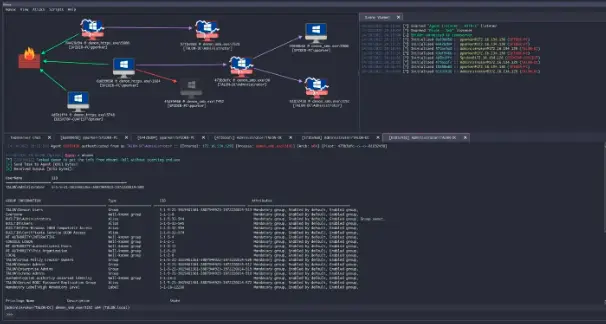
APT36 zero in sights a handful of data types army personnel files, foreign‑affairs and diplomatic messages, strategy and policy documents, defense procurement records, national‑security planning files, and credentials stolen from browser password stores.In most cases the targets were jammed with several implants at once. Each implant speaks a different language uses a C2 protocol and runs in parallel. If one is spotted and knocked out the rest keep the network breathing.The core of the operation is still a human‑directed effort only the toolchain itself is automated.These pictures credit goes to bit defender
4. How to Defend Against AI-Generated Nation-State Malware
Traditional signature‑based endpoint tools are simply falling short against vibeware campaigns. Instead of chasing down binary patterns, security teams need to live in the behaviour of the software watching the specific API call chains the way files are accessed and tweaked, or how browser shortcuts are altered.These are the red flags that new language variants can’t just dodge.
Equally, traffic to everyday cloud services Google Workspace, Slack, Discord deserves a second look. A simple reputation check on the destination can miss a lot.Attackers that use LOTS‑based C2 leave almost no traces for conventional network tools so the content and the way the traffic behaves become critical. Keep your eyes on the actual data flowing and you’ll catch those stealthy moves before they take a hard line.
Government and diplomatic organizations should enforce zero-trust architecture that treats all cloud service communications as potentially malicious until verified,restrict USB and removable media usage at classified workstations and deploy Data Loss Prevention (DLP) controls aligned to the BackupSpy harvesting profile. Phishing awareness training must specifically address the growing use of ISO and ZIP archives delivering LNK shortcut payloads.A vector can bypasses many legacy email security gateways.Monitoring Linkedin and professional networks for unusual external research patterns and targeting employee profiles is no longer optional for high-risk government entities and APT36 has demonstrated it is a core step in their targeting methodology.
The APT36 vibeware campaign is a preview of the next five years of nation-state cyber conflict. As AI code generation tools become more capable and more accessible the barrier between a modestly resourced threat group and an industrialized malware production pipeline will continue to collapse.The defenders who will survive this shift are not those with the best signature databases.They are those who build detection systems as adaptive, behavioral and AI-assisted as the attacks they face.