In March 2026 EXPMON researcher Haifei Li discovered a dangerous zero-day vulnerability that could steal your entire computers data just by opening a PDF file and Adobe hasn’t released a patch yet.You didn’t have to open any links and install any software just a PDF file and the hackers were inside your computer. Learn the full truth about this sophisticated attack.
The Malicious PDF That Shocked Everyone
On March 26, 2026, cybersecurity researcher Haifei Li system discovered something strange. There was no malware no virus and no suspicious executable file just a PDF file named yummy_adobe_exploit_uwu.pdf.But what was inside this file could render any of the latest Adobe Readers useless.
EXPMON advanced behavioral analytics flagged this file because some very unusual activities were taking place in Acrobats JavaScript engine. When researchers analyzed this file in depth and what emerged stunned in the cybersecurity community.
This was a zero day vulnerability that is a vulnerability which even Adobe itself was not aware and for which no patch or fix is available in the market yet. This exploit works successfully even on the latest version of Adobe Reader 26.00121367.
Meaning even if you have updated Adobe Reader even today and you are still not safe. When this file was checked on VirusTotal only 5 antivirus engines marked it suspicious and the remaining 59 engines declared it completely safe.This is particularly alarming because it means that most security systems in the world are not even equipped to detect this threat.
What Is a Zero-Day And Why Is It So Dangerous?
The term zero-day may sound a bit technical but the concept is quite simple. When software contains a vulnerability that the company that created it doesn’t even know about its called a zero-day. Its a no-brainer that the company has zero days to fix the vulnerability.
This is a golden opportunity for hackers.They exploit the vulnerability before the company realizes it and releases a patch. In some cases this gap can last weeks in others months and in this case the patch hasn’t been released yet.
Adobe Reader is the most widely used PDF software in the world. Its present everywhere in the offices, universities, government departments and hospitals. When a zero-day is found in such software, it means that the systems of millions of people are at risk at the same time. And when this zero-day can be triggered by a PDF so easily available that even an antivirus cannot detect it and then its not just a cybersecurity incident but a widespread public threat.
Inside the Attack Step-by-Step Execution Explained
This attack is a very carefully designed multi-stage operation. First hackers created a malicious PDF file with JavaScript code hidden deep within form objects. This JavaScript was not written directly but was obfuscated using Base64 encoding which means that the code was converted into a language that normal tools and antivirus engines cannot understand. When a victim simply opens this PDF file and no button has to be pressed and no link has to be opened just the file has to be opened and then this JavaScript gets executed automatically.
Once executed, this code abuses two specific internal APIs of Adobe Reader that should only be used by trusted, privileged processes. The first API is util.readFileIntoStream() and it is the tool that normally helps Adobe Reader read local files for its work. Hackers weaponized it.

As you see the upper image Wireshark Packet Capture of the exploits TCP connection flow at IP 169.40.2.68:45191. Each packet clearly shows the entire attack digital trail from SYN to HTTP GET request.
This API reads local system files of the victim’s computer and specifically the ntdll.dll file a core component of the Windows operating system to find out the exact OS version Adobe Reader version system language settings and the local file path of the PDF. All this information creates a picture of the victims computer. Researchers call this process fingerprinting.
The second API is RSS.addFeed() This was normally an RSS feed feature of Adobe which is now mostly not used. But hackers used it as a Command-and-Control (C2) channel. This API silently sends all the collected information of the victim’s system to the hackers remote server at IP address 169.40.2.68:45191. The server receives this data and decides whether the victim is useful to them or not.
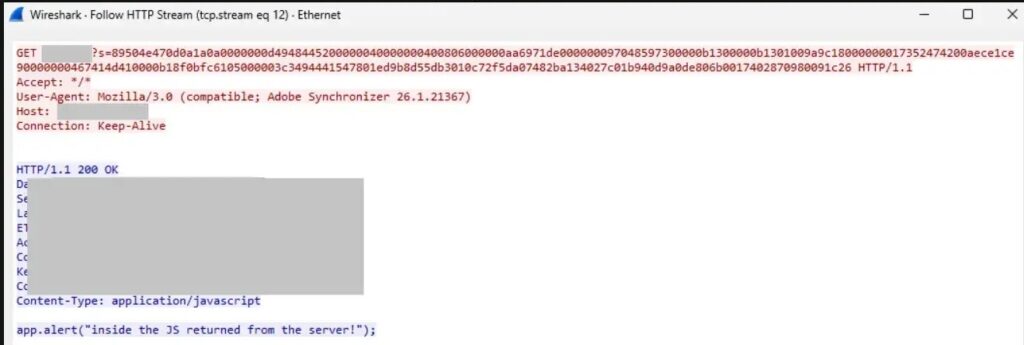
The Wireshark HTTP Stream User-Agent shows Adobe Synchronizer 26.1.21367 which is the disguised identity of the exploit. Most importantly: the server returned a JavaScript payload app.alert (inside the JS returned from the server) which is live proof that the C2 server can indeed execute malicious code.
If the victim turns out to be a valuable target like a corporate employee, government official or high-value individual and the same RSS.addFeed() connection is used to send encrypted and obfuscated secondary JavaScript payloads to the server that can lead to Remote Code Execution (RCE) meaning hackers take complete control of your computer.
Russian Decoy Files Reveal Hackers Real Motives
A very revealing detail of this campaign came to light in a forensic analysis on GitHub. When researchers deeply analyzed these malicious PDF files, they found that when opened and these files show documents in Russian language as visual decoys. One PDF contained a document in Russian with a title that seemed to be related to some organizational procedures. These decoy documents are there so that whoever opens this PDF does not feel anything strange and does not close the file until the exploit has done its work.
Only two samples of this campaign have been identified in the wild so far, which clearly suggests one thing: this is not a mass phishing campaign. Its a highly targeted operation. Hackers send these PDFs to carefully chosen targets, perhaps via email or messaging platforms and server-side filtering is implemented so that only victims who meet their strict criteria receive the full payload. Sandbox environments such as researchers testing systems and often return empty server responses. This means hackers are very careful not to expose their attack.
EXPMON and Haifei Li The Researcher Who Warned the World
The man behind this entire discovery is Haifei Li. He is an independent cybersecurity researcher who developed a platform called EXPMON. EXPMON is a sandbox-based exploit detection system specifically designed to detect zero-day vulnerabilities and advanced exploits, and uses a completely different approach than traditional antivirus or malware focused tools.
Haifei Li says he created EXPMON because he noticed that no system in the world specifically focuses on detecting exploit behavior and all of them only look for malware. But if an attack works without dropping malware and they miss everything.
This isn’t the first time Haifei Li has discovered an Adobe Reader zero-day. He also discovered an Adobe Reader zero-day in June 2024 which Adobe later released a patch for. However the patch was incomplete at that time,and EXPMON discovered that as well. He reported this new 2026 zero-day finding to Adobe Security under responsible disclosure. Howeverat the time of writing, there has been no official patch release from Adobe. This is a serious gap, and the cybersecurity community is quite concerned.
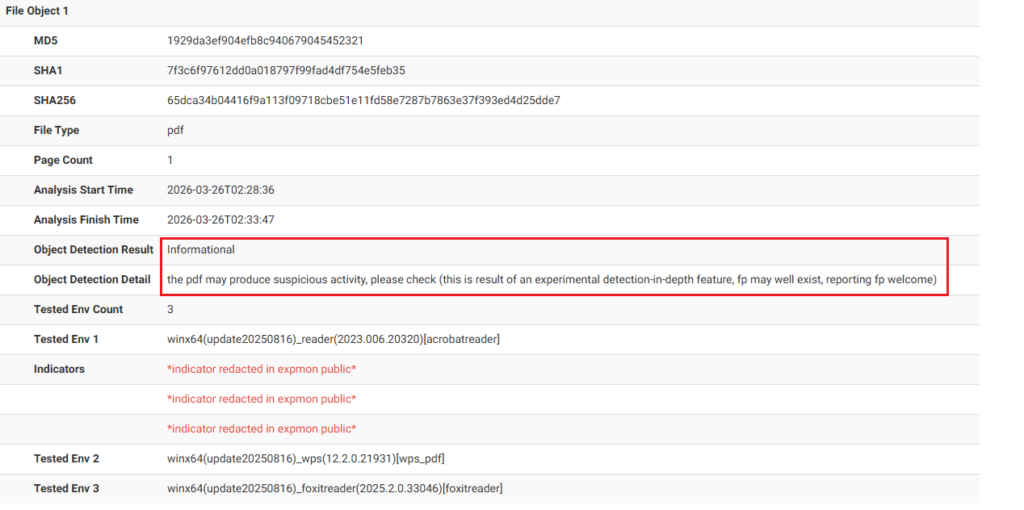
EXPMON official analysis report on March 26, 2026. Scan results of a malicious PDF. Tested in three different environments Adobe Acrobat Reader, WPS PDF, and Foxit Reader. Object Detection flagged suspicious activity while traditional antivirus engines completely missed it. Indicators have been deliberately redacted to avoid alerting attackers.
Sandbox Escape How Attackers Take Full Control of a System
Adobe Reader runs in a sandbox environment. A sandbox is an isolated digital space where Adobe Reader works but cannot go outside its boundaries. This security feature was created so that even if a malicious PDF is opened, it can only act within the limited environment of the Reader and cannot touch the rest of the computer. The biggest achievement of this attack is that it can bypass the sandbox.
Researchers have demonstrated in a controlled environment that encrypted JavaScript payloads coming from the RSS.addFeed() channel can execute within Adobe Reader and reach the Sandbox Escape (SBX) loophole and allowing it to breach this boundary and gain access to the entire system.
Once the sandbox is escaped hackers theoretically have control of the entire system. They can delete files, copy data, install keyloggers that record your passwords or even permanently install their own system on your computer to gain repeated access. This combination of Remote Code Execution (RCE) + Sandbox Escape is considered a nightmare scenario in the world of cybersecurity and this exploit suggests exactly that.
How to Protect Yourself Practical Security Steps
First and foremost Until Adobe releases an official patch do not open any PDF file from an unknown source. Whether its email, WhatsApp, or a link sent to you if you don’t know the source don’t open it at all. The trigger for this exploit is simply opening the file not any other step so following this one step can protect you from serious danger. Organizations and IT departments should monitor their networks for anomalous HTTP or HTTPS traffic containing the Adobe Synchronizer User-Agent field. This is a known indicator of this attack.
Network defenders should block the known malicious IP address 169.40.2.68:45191 but this is a temporary measure as hackers can easily change their infrastructure. A more effective approach is to restrict JavaScript execution of PDF files and disable JavaScript in Adobe Readers settings until a patch is released.
If you use an alternative PDF reader instead of Adobe Reader such as browser-based PDF viewers or Microsoft Edges built-in PDF viewer you are currently protected from this specific exploit as this vulnerability is specifically in Adobe Readers JavaScript engine.
Conclusion One PDF Exposed a Global Security Reality
This Adobe Reader zero-day isn’t just a technical vulnerability it’s a powerful reminder of how vulnerable we are in digital life. We open millions of PDF files every day office documents, resumes, invoices government forms and always assume they’re safe. This attack shattered that assumption.
A professional looking PDF even one your antivirus says is safe can steal data from your entire system without you even realizing it. A zero-day in mass-market software like Adobe Reader means this threat could reach millions of people.
Haifei Li and EXPMON prevented a major threat by timely discovering and disclosing this vulnerability but the real question now is when Adobe will release a patch. Until a patch is released every Adobe Reader user will have to remain hyper-vigilant. Its a common truth in the world of cybersecurity attackers only need a vulnerability and defenders need to protect everything, at all times. In this case that vulnerability is a PDF fileand that file could arrive in your inbox at any time.