The digital battlefield is always changing.While many focus on overt threats like ransomware or phishing the true threat frequently resides deeper within the tools we rely on. The discovery of GlassWorm a sophisticated supply-chain poisoning campaign that played on developer ecosystems and revealed a horrible new frontier in cyberwarfare, rocked the cybersecurity community in March 2026.
Instead the directly targeting end users this attack targeted the architects and builders of our digital world transforming their trusted extensions into Trojan horses. It takes more than just technical knowledge and understand GlassWorm.It also requires boosting the foundations of our software supply chains and identifying the evolving strategies of adversaries.
The Open VSX registry a popular hub for extensions utilised in Integrated Development Environments (IDEs) like VS Code, was the central mechanism of GlassWorm. 72 malicious extensions were carefully created by attackers to look authentic and helpful. These weren’t crude, obvious fakes; instead, they were deftly designed to imitate well-known features or provide ostensibly harmless utilities, pulling developers to download them.
These malicious extensions didn’t start causing chaos right away after they were installed. Rather, they carefully created a backdoor that gave the attackers ongoing access to the developer’s computer. The threat actors were able to observe activities, steal credentials, and the most importantly manipulate the source code that was being developed thanks to this covert infiltration.
How GlassWorm Sneaked In: The Art of Supply Chain Poisoning
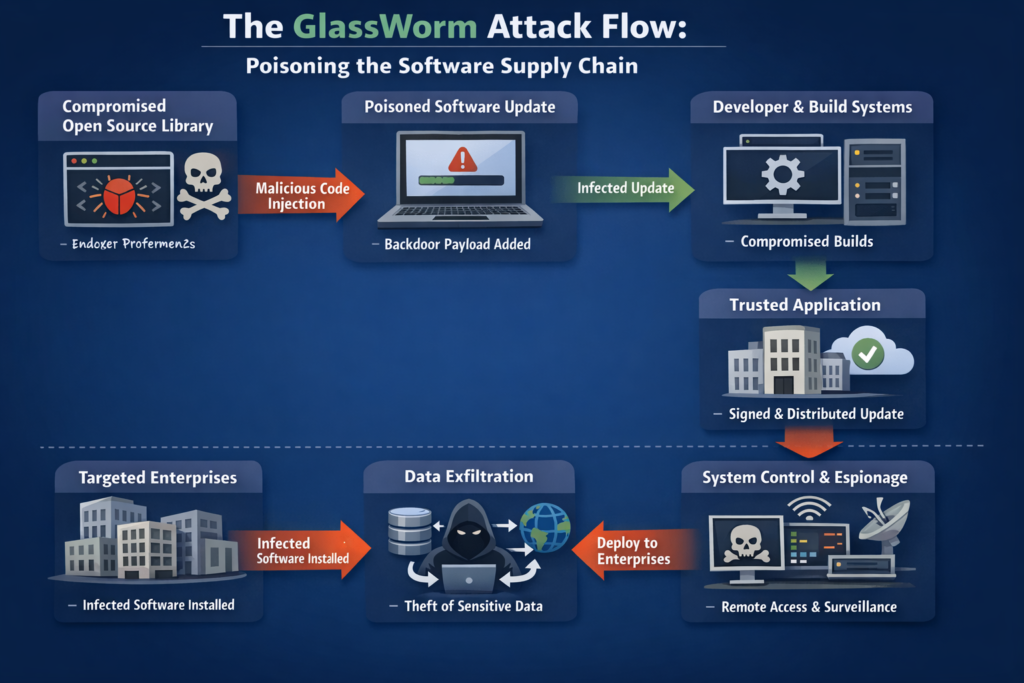
The phrase supply chain poisoning adds up GlassWorm methodology quite well.Consider a product, such as a well known software program that undergoes different phases of development involving a variety of tools and components before it is delivered to the end users.This is supply chain.
Adversaries in a supply chain poisoning attack typically do not target the end user or the final product directly.Rather they introduce backdoors or malicious code earlier on the frequently in the tools or components and used to create that product.The malicious code that was founded into the developer extensions that appeared harmless was the poison in the GlassWorm case.
This means that any program or update distributed by the hacked developer might accidentally contain the attacker’s payload, infecting thousands or even millions of users downstream.Because it makes use of trust, this strategy is especially effective. Developers download their necessary tools from marketplaces and registries, which they naturally trust.
They believe that these platforms have been thoroughly examined and are safe. By carefully taking advantage of this trust.GlassWorm made it difficult to tell between malicious and safe extensions. Such an attack has far-reaching effects that go well beyond the immediate compromise of a single machine.
Entire companies that depend on the software created by the impacted developers could be compromised. The consequences for data theft, intellectual property loss, and systemic disruption are huge if a large tech company unintentionally ships a backdoor created by a GlassWorm-infected developer.The event draws attention to a crucial weakness in modern software development: the widespread use of third-party components and built-in confidence in popular development ecosystems, which makes them easy targets for skilled adversaries.
Zero Trust for Developers: Redefining Security Posture After the GlassWorm Attack
The GlassWorm campaign is a clear reminder that in a time of decentralised development, conventional perimeter defences are becoming more and more ineffective. The critical attack vectors within the software supply chain itself are overlooked when focusing only on network firewalls and endpoint security.
Organisations now need to take a more active and comprehensive approach to security, realising that their weakest link may be an internal dependency rather than an external threat.While encouraging innovation, the quick reception of open-source components and third-party integrations presents serious risks if improperly handled.
This means setting in place stringent screening procedures for all third-party tools, keeping an up-to-date list of software dependencies, and constantly keeping an eye out for questionable activity in development environments.
The event highlights the need for a strong Software Bill of Materials (SBOM) which enables businesses to figure out each digital ingredient and spot possible weaknesses before they are exploited.GlassWorm impact can’t be ignored.It forces us to change how engineering teams think about security.No longer can it be a side note or the job of just one department.Rather protection has to flow through every step of the software‑development process.
Developers must start learning to spot the cues of sophisticated impersonation straight away.They also need to understand why untrusted IDE extensions can open a door to attacks.By training them from day one to secure coding can become a natural part of building not an afterthought you add later.In short, make security a built‑in habit rather than a bolt‑on feature.
Strong access controls, hardware‑based MFA and automated code signing aren’t optional luxuries anymore the lifeline of today’s software world.If you work in the supply chain, whatever your role you’re part of a shared shield that must stand firm.Freelancers, small‑team devs and large‑scale architects all face the same challenge: build resilience, not just patch after a breach.