Security researcher Nightmare-Eclipse publicly released a proof of concept exploit named LegacyHive targeting the Windows User Profile Service that lets a standard local user silently mount another users registry hive including administrator hives under their own session with no patch available as of July 2026.
Picture sitting on a shared Windows workstation as a standard user with no admin rights and within seconds quietly mounting a senior administrators registry hive under your own session. No exploit kit needed. No network connection required. No dramatic error messages appearing anywhere on the screen.
Just a silent manipulation of the way Windows loads and manages user profiles and suddenly every registry value belonging to a privileged account sits readable and potentially manipulable right from your own session. That exact capability arrived publicly on July 15 2026 when security researcher Nightmare-Eclipse published a proof of concept named LegacyHive targeting a Windows User Profile Service elevation of privilege vulnerability with no CVE assigned and no patch available.
LegacyHive Arbitrary Hive Load Explained
Windows registry hives represent far more than simple configuration files. Every major behavioral decision Windows makes about how software launches how file types open how COM objects resolve and how user specific settings apply all flows through registry hive data.
The NTUSER.DAT file holds the bulk of a standard user’s configuration while the UsrClass.dat hive carries file associations shell settings COM configurations and application class settings that directly influence how software interacts with the operating system on behalf of that specific user.
The Windows User Profile Service manages loading and unloading these hive files as users log in and log out. When a user profile loads the service maps that users hive into the registry namespace making it accessible for that session and that session only. The core security assumption underneath this entire system says that one user’s hive files stay completely inaccessible to any other users session unless administrative privilege has already been granted. LegacyHive breaks that assumption entirely.
The GitHub repository published by Nightmare-Eclipse describes LegacyHive as a Windows user profile service arbitrary hive load elevation of privileges vulnerability. The repository appeared with source code and documentation roughly eleven hours before it became publicly accessible and carries an MIT license meaning anyone can freely use modify and redistribute the code without restriction.
In its full unrestricted form the original technique required no additional user credentials beyond the standard account already executing the exploit. The researcher intentionally restricted the public release to reduce the risk of immediate mass abuse by requiring credentials for a second standard user and the username of a target third account which may be an administrator.
This intentional gate limits casual exploitation but security professionals and threat actors with any degree of sophistication can work around an intentionally simplified public release once they understand the underlying technique. The researcher explicitly acknowledged that the original exploit loaded arbitrary hives without restriction and was not limited only to the UsrClass.dat file making the full technique applicable to NTUSER.DAT and any other hive file the attacker chooses to target.
When executed successfully the target accounts user hive mounts within the current user’s classes registry location. That mounting gives the executing user direct read access to registry values that Windows normally treats as completely isolated to the target account. The security sensitivity of this result flows directly from what those registry values control.
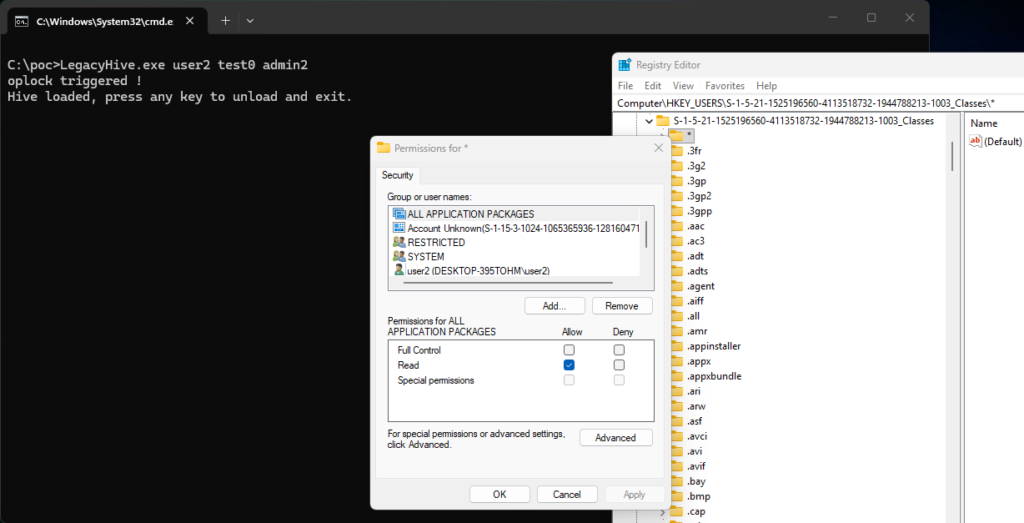
(source: Nightmare-Eclipse GitHub)
Any attacker who reads a privileged users registry hive can identify escalation paths specific to that machines configuration including references to software installed under admin privileges COM object registrations that could be redirected and user specific startup entries that only execute under the target’s session context.
The disclosure carries no CVE number no Microsoft security advisory and no official patch targeting this specific behavior. That combination sits at the most uncomfortable point in the responsible disclosure spectrum. A working proof of concept with public code and MIT licensing now sits available for anyone to download while Microsoft has not yet acknowledged the report or confirmed any remediation timeline.
The researchers own statement that the PoC works on all supported Windows desktop and server versions with the July 2026 cumulative updates already installed confirms that routine monthly patching provides no protection against this specific technique.
The timing of the public release on July 15 2026 the same day as Microsofts July Patch Tuesday release adds operational context. The researcher appears to have waited for the latest available cumulative update cycle and then confirmed the vulnerability persisted before proceeding to full public release. This confirmation on fully patched systems removes any ambiguity about whether keeping Windows updated resolves the issue.
LegacyHive Detection Indicators And Defense Mitigation Guide
Detection for this class of attack centers on monitoring for unexpected profile loading activity rather than on file signatures or network connections since LegacyHive operates entirely within local system calls.
Windows Security Event Log event ID 4688 which logs process creation and event ID 4616 which logs system time changes provide some useful baseline but the most directly relevant telemetry sits in Windows events related to registry hive loading specifically looking for calls to the NtLoadKey or RegLoadKey functions originating from user level processes rather than from system or service contexts.
Endpoint detection and response platforms that monitor kernel level registry operations rather than only user space API calls offer the most reliable visibility here since the User Profile Service runs in a privileged context and any manipulation of its hive loading behavior produces anomalies at the kernel call layer before any filesystem change becomes visible.
Security teams should specifically build detection logic around any user level process triggering a registry hive load operation against a hive path belonging to a different user account since this combination represents the core behavioral signature of LegacyHive even if the specific executable name or path changes across different deployments.
Filesystem monitoring on the paths where user profile hive files sit specifically the AppDataLocalMicrosoft path for UsrClass.dat and the user profile root for NTUSER.DAT provides a secondary detection layer. Any access to these files from a process running under a different user accounts token warrants immediate investigation since Windows does not normally produce this access pattern during standard operation.
Network defenders should note that this vulnerability produces no network traffic by design meaning perimeter monitoring and network based detection provide zero visibility into exploitation attempts. The threat lives entirely within the local system boundary making endpoint telemetry the only reliable detection source.
Windows administrators managing multi user environments shared workstations shared terminal server sessions and educational or enterprise environments where multiple standard users share access to physical or virtual machines should treat local user access restrictions as an immediate priority.
Restricting interactive local logon to only accounts that genuinely require it reduces the population of sessions from which this technique could launch. The principle of least privilege applied to local logon rights through Group Policy specifically the deny local logon and allow log on locally policy settings provides a meaningful reduction in practical exposure even before any patch becomes available.
Organizations running privileged access workstations or jump servers where administrator accounts authenticate alongside standard accounts in any shared session context face elevated risk from this specific technique since those environments concentrate exactly the administrator hive data that LegacyHive targets. Separating privileged account authentication to dedicated systems with no standard user co-tenancy removes the most dangerous exposure scenario.
Microsoft’s typical response timeline for researcher disclosed Windows privilege escalation vulnerabilities runs between thirty and ninety days from initial report to patch availability depending on complexity and exploitation activity.
Given that the July 2026 Patch Tuesday cycle already closed without addressing this vulnerability the earliest realistic patch delivery falls to the August 2026 update cycle at minimum. Security teams should track Microsoft Security Response Center communications for any out of band advisory and should plan endpoint telemetry coverage to fill the detection gap until a patch arrives.
LegacyHive joins a notable pattern of Windows User Profile Service vulnerabilities over recent years. CVE-2021-34484 and CVE-2022-21919 both targeted similar profile loading mechanisms and both took multiple patch attempts before reaching full remediation.
That history suggests the underlying complexity in how Windows manages profile data creates recurrent opportunities for researchers to find adjacent flaws even after individual specific CVEs get closed and makes a comprehensive architectural review of the User Profile Service loading mechanism the most durable long term recommendation rather than waiting for each incremental variant to receive its own patch cycle.