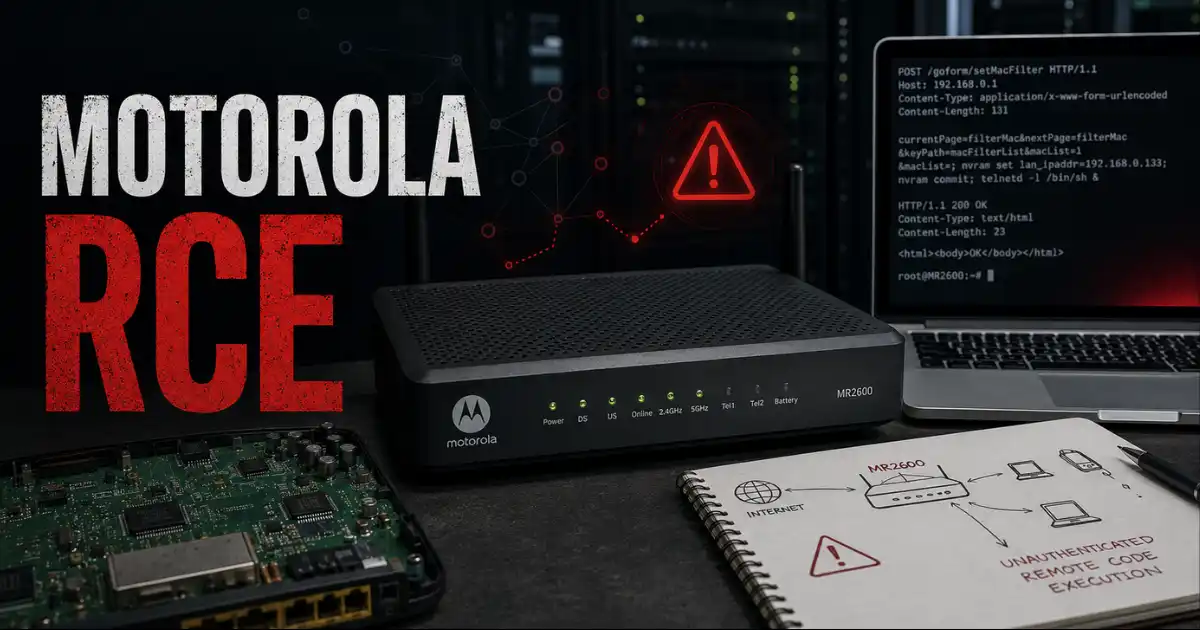
Security researcher MrBruh disclosed a full unauthenticated remote code execution vulnerability in the Motorola MR2600 router allowing any attacker on the LAN or internet to flash malicious firmware without credentials using two bypassed authentication checks.
Imagine you are sitting on a coffee shop network or a home LAN with a Motorola MR2600 router nearby and within minutes flashing that router with completely custom malicious firmware without ever entering a password. No brute force. No social engineering.
Just two HTTP requests and the router reboots running whatever code you decided to put inside it. That exact exploit chain now sits fully public after security researcher MrBruh published a detailed disclosure on July 13 2026 following Motorolas refusal to claim ownership of the product through either of its two divisions.
Motorola Firmware Upload Exploit
The Motorola MR2600 runs a firmware management system exposing two critical endpoints. The first handles firmware uploads through a CGI script at the path POST /WEBCGI1/prog.fcgi pointing to /cgi-bin/fwupload.cgi and the second handles firmware validation and flashing through a SOAP endpoint at POST /WEBCGI1/ using the SOAPAction LoadFirmwareValidation.
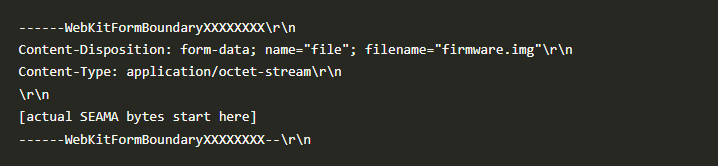
fwupload.cgi endpoint.Both endpoints were supposed to require authentication and both fail to enforce it in ways that combine into a complete and reliable attack chain.The upload endpoint carries a flawed multipart parsing implementation where the developer attempted to validate that an uploaded file begins with the SEAMA image magic bytes 0x27 0x05 0x19 0x56.

However the validation runs against the raw multipart data rather than against the extracted file payload meaning the check always fails during legitimate use because multipart boundaries begin with four dashes rather than those bytes.
An attacker bypasses this by simply sending the raw firmware image without any multipart boundary at all causing the validation check to pass while the actual authentication check fires only after the file already lands in the filesystem at /tmp/firmware.img. Critically the authentication failure does nothing to delete the file that already sits there.
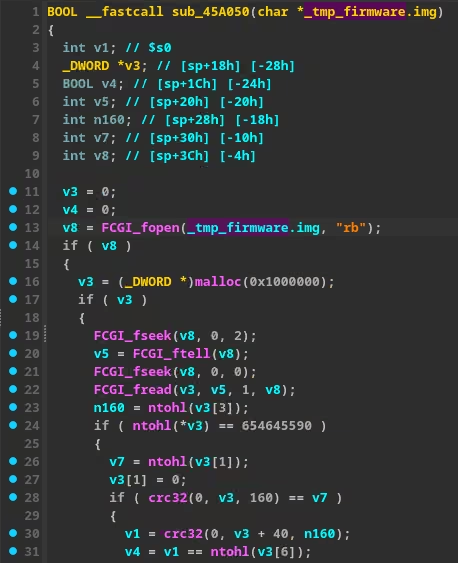
The flashing endpoint carries an equally significant mistake rooted in inconsistent comparison logic. The authentication checking function uses a substring match to find allowlisted paths but uses an exact equality check to identify the denylisted path /WEBCGI1/.
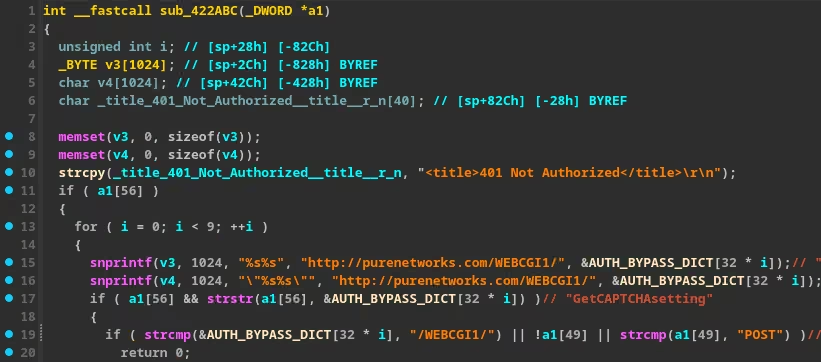
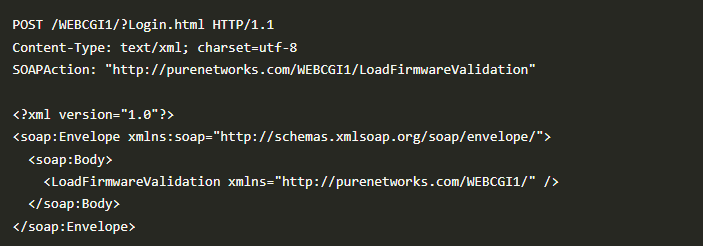
Any attacker who appends a query parameter containing an allowlisted string such as Login.html causes the endpoint to pass the allowlist check since the URI contains the expected substring while simultaneously failing the denylist check since the URI no longer exactly equals /WEBCGI1/. The result is that a request to POST /WEBCGI1/?Login.html with the LoadFirmwareValidation SOAP body bypasses authentication entirely.
The complete exploit chain flows in three steps. The attacker uploads a malicious firmware image through the fwupload endpoint without any multipart boundary which bypasses the SEAMA magic check and the authentication check fires too late to delete the file. The attacker then calls LoadFirmwareValidation through the SOAP endpoint with the Login.html query parameter appended which bypasses authentication and triggers the firmware validation routine.
The SEAMA validation and CRC32 integrity check pass because anyone can generate a correctly formatted SEAMA image since Motorola requires no cryptographic signing to prove the firmware originated from them. The router flashes the new firmware and reboots running whatever code the attacker placed inside the image.
Motorola offered no patch path. The MR2600 sits at end of life status and has received no firmware updates since v1.0.22 in mid-2024. The automatic update infrastructure the router would normally use to pull patches pointed to a domain zoom.com which no longer belongs to any router manufacturer and now sits under a telecommunications SaaS company.
MrBruh attempted responsible disclosure by contacting Motorola Mobility who claimed the product belonged to Motorola Solutions and then contacting Motorola Solutions who claimed it belonged to Motorola Mobility. With neither division willing to claim ownership of an end of life product MrBruh proceeded to full public disclosure.
MR2600 Exposure Scope And Mitigation Recommendations
At minimum this exploit fires from any machine on the same LAN as an affected router without requiring any credentials. The exposure extends to the public internet for any MR2600 with remote management enabled. Shodan identified 41 MR2600 routers exposed on the internet with remote management active at the time of disclosure meaning those devices face full remote unauthenticated firmware replacement right now from anyone anywhere.
The practical impact of a router firmware replacement attack extends well beyond the router itself. Custom firmware on a home or small office router can silently intercept DNS responses redirect traffic to phishing infrastructure capture cleartext credentials from unencrypted sessions and serve as a persistent network level implant that survives every device replacement above it on the network since the threat lives in the network infrastructure rather than any individual device.
Owners of the Motorola MR2600 should treat this device as permanently compromised at the network level and replace it immediately with a supported router that receives active security patches. Disabling remote management as a minimum mitigation reduces exposure to LAN only exploitation but does not eliminate the threat for any machine already on that local network including guest devices and IoT equipment that may themselves carry additional attack surface.
Bug bounty context here deserves specific attention. MrBruh noted that across personal reports submitted to AMD ASUS Google Motorola MSI Netgear TP-Link and others the total compensation received stands at exactly zero dollars. The Motorola case specifically demonstrates that end of life products create a structural gap in vulnerability response where no internal team claims ownership and no patch pathway exists leaving independent security researchers with no viable path other than full public disclosure after vendor communication fails entirely.